Why this is different.
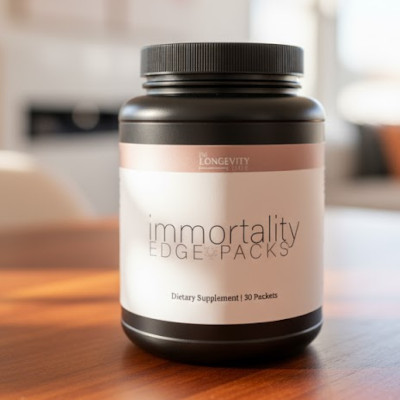
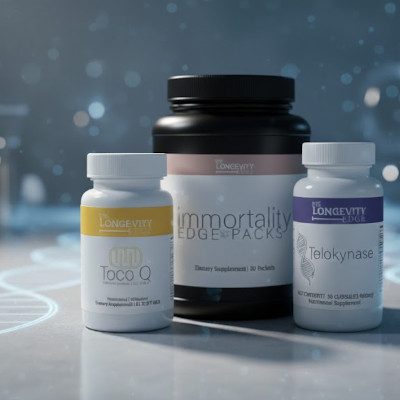
For fifteen years, when patients asked me what to take for their telomeres, I gave the same short list. The first-generation telomerase activator if you could afford it. The lower-cost cycloastragenol products if you could not. The Immortality Edge Packs around either one, because the activator does not work in isolation, it works on top of a multi, a clinical-dose fish oil, and the supporting nutrients I have written about since the book came out. That answer did not change for fifteen years, because for fifteen years nothing in this category was worth a second answer.
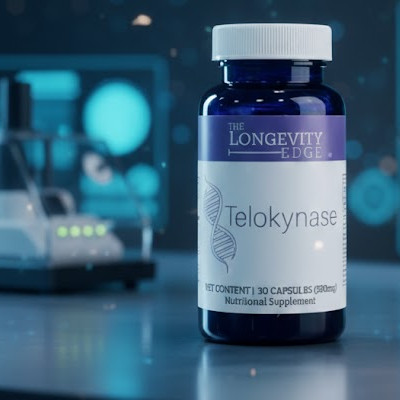
Three years ago I started looking for one anyway. I have never believed nature produced exactly one molecule capable of activating telomerase. Biochemistry rarely produces a single solution to a problem this central to cell biology, and the plant kingdom is too diverse for the first compound a research team isolated to be the only one. So I went looking. What I found took two years longer than I wanted to bring to a bottle. Telokynase is the result.
What I will tell you about this molecule, and what I will not.
I will tell you the in-vitro work is real, that I have spent more time looking at this compound than at any compound in the last decade, and that I have been taking it myself since 2018. In our own TRAP-assay work, the new molecule produced telomerase activity in the range of two to three times the first-generation reference, and added three additional passages to mesenchymal stem cells in culture compared with untreated controls. The stem-cell passage data is the readout that closed the case for me as a clinician. I will not tell you it has been proven in a randomized controlled human trial, because it has not. I will not tell you it treats, reverses, or prevents any condition, because that is not the standard the data supports yet, and it is not the standard I am willing to claim against. If a product page is going to make a claim about your biology, the writer should be willing to defend it the way a doctor would have to defend it. That is the rule I write to, on this page and every other one in this catalog.
Why I cared enough to do this.
My father’s death was untimely, and it was the moment everything I had been reading about telomeres, mitochondrial decline, and the upstream biology of aging stopped being abstract for me. The mission I have been on ever since is to reduce the suffering, infirmity, and loss-of-self that come with growing older, and to live as long, as healthy, and as capable as I can in the time I have. Telokynase belongs to that mission.
The case for telomerase activation, in plain language. Telomeres are the biological time clocks at the ends of your chromosomes that record how much of the original cellular runway is left. As they shorten, and as the dysfunction that comes with that shortening sets in, the cell’s ability to generate energy weakens, the ability to produce healthy daughter cells weakens with it, and the steady inflammatory drift researchers now call “inflammaging” turns from a trickle into a current. That drift is not the kind you can fix with better food or better sleep, important as both are. It comes from the inside out. Activating telomerase is the most accessible lever I know of for slowing that drift, and Telokynase is the molecule I built around that lever.
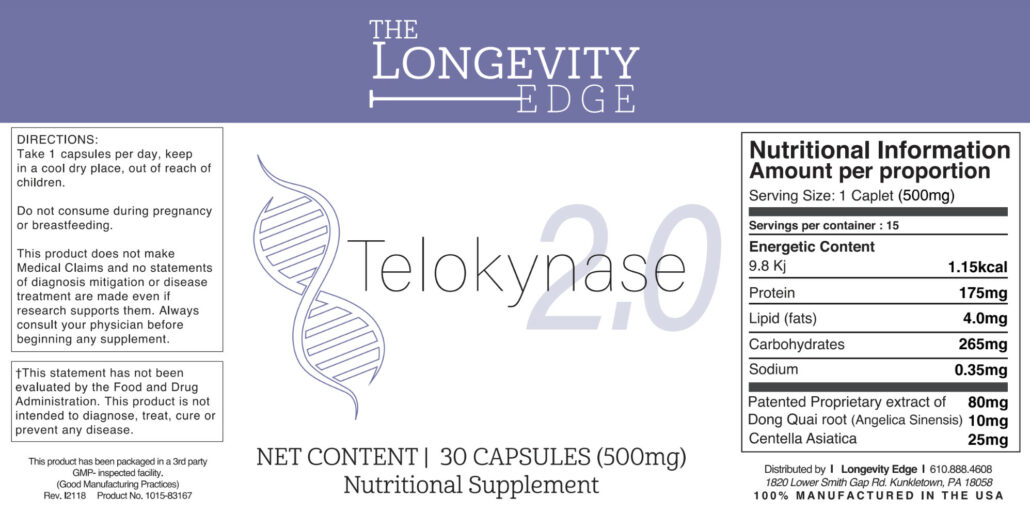
Most of what is sold as “telomerase support” today is the same astragalus-derived chemistry the first-generation activator made famous, in lower-purity extracts, dosed at a fraction of what the original studies used, sold through MLM channels at a price that has nothing to do with the cost of goods. Telokynase is none of that. It is in a different chemical class, from a different plant family, at a clinical dose, manufactured in a third-party GMP-certified facility in the United States, with no astragalus and no cycloastragenol in the bottle. The active compound is patent-pending and the chemical name is held back until the patent grants. I would prefer to put the name on the label. I am not going to until the patent issues, because naming it now makes it easier for a larger competitor to file around the work and ship a copy before the patent grants. The 80 mg blend on the label contains 25 mg Centella and 10 mg Dong Quai disclosed at their actual weights, and 45 mg of the patent-pending active by subtraction. The day the patent grants, the chemical name goes on the bottle. The full per-ingredient detail is in the cards below.
What I am taking now.
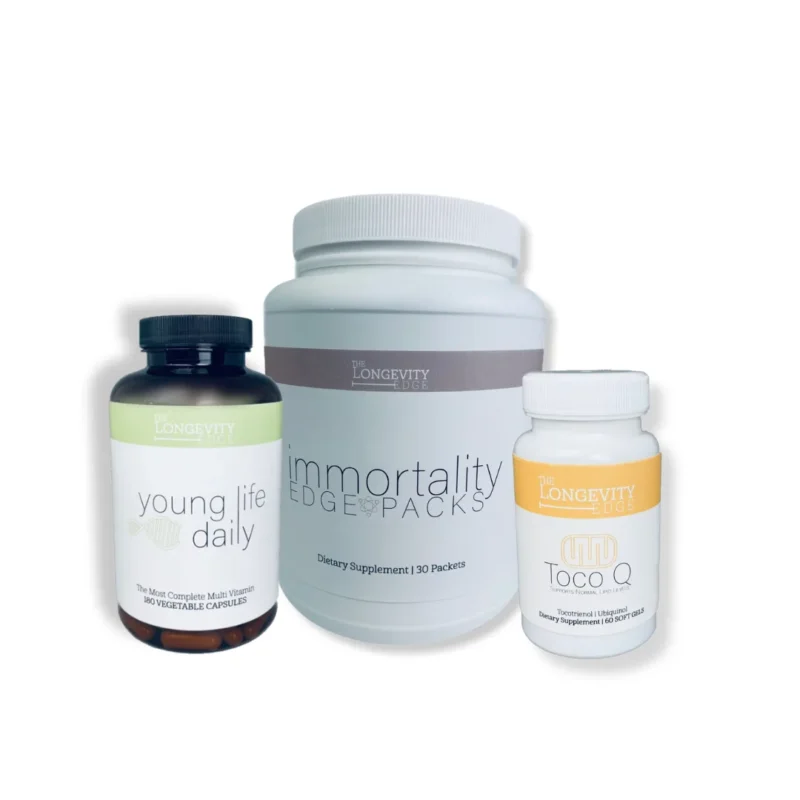
I have been on Telokynase daily since 2018. One caplet in the morning, on an empty stomach, with the Immortality Edge Packs an hour later. The first-generation activator I had taken for years came off my shelf when this went on. I did not run the two together. I wanted my own telomere measurements to be a clean read of what the new mechanism does on its own.
This is for the customer who has been reading me since The Immortality Edge came out in 2010, has run a telomere panel at least once, is already on the basics, and is interested in the next molecule that earns its place in the routine they have spent fifteen years building. It is for the customer in their sixties or seventies with the resources and the discipline to run a real protocol with their bloodwork. It is not the right product for someone who wants to feel something in two weeks and quit. The bottle is too serious for that, and so is the timeline.
If you have been on a cycloastragenol-based activator for a year or more, this is the conversation to have with yourself and with your doctor. Either as a replacement, or alongside the older activator for the next twelve months while we keep watching the data.
Doc