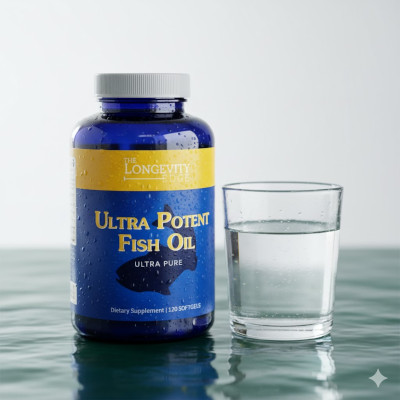
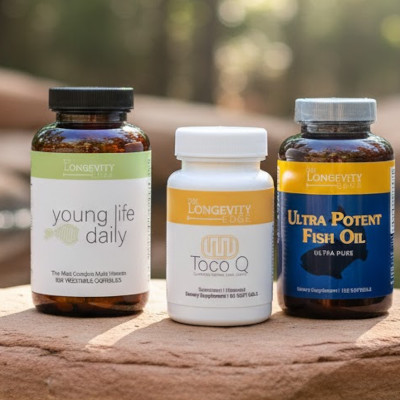
The fish oil you can actually verify.
You have been swallowing the same softgels for years. Maybe a decade. You take them with breakfast because that is the habit, and somewhere along the way it stopped being a decision and became a thing you just do. And if you are honest, you could not tell me what they are doing for you. You cannot feel them. You have never measured them. You are trusting a number printed on the front of a bottle by a company that has every reason to round it up.
That is not a knock on you. It is the whole problem with this category. A pharmaceutical grade fish oil should be the easiest supplement in the world to trust, because everything that matters about it can be measured in a lab. How concentrated it really is. Whether the toxins are actually gone. Whether the oil is still fresh by the time it reaches you. The trouble is that almost nobody measures those things where you can see them, and the ones who do not measure them are counting on exactly that.
I went looking for a fish oil I could trust years ago, and I could not find one. So I built my own. That was nearly twenty years ago. It has been my top seller every year since, and it is still the oil I hold every other fish oil up against.
“I have taken fish oil every day for ten years. How would I even know if it is doing anything?”
That is the right question. It is the one almost nobody can answer for the bottle in their cabinet. This page is my answer for this one, and the answer is made of numbers you can check, not adjectives.
How I got here
I will be straight with you about why I went looking in the first place. Years ago, at the peak of my training and my career, my blood pressure climbed into a range that got my attention and sent me back into the research. The research on high-dose, high-purity EPA and DHA was too strong to ignore, and I wanted the cleanest, most potent version I could put into my own routine while I took care of myself the way my doctor and I had mapped out. I tested what was on the market. Most of it was underdosed, oxidized, or both. None of it was good enough to be the one I took every day.
So I made the one I would take every day. I still take it. That is the short version of where this product came from.
Why the fish oil in your cabinet probably falls short
Two things go wrong in this category, and most bottles get at least one of them wrong.
The first is the trade between potency and form. Natural fish oil is only about 30% EPA and DHA. The rest is fat you do not need. To get a real, research-level dose out of a 30% oil you would be swallowing a small handful of softgels every day, so most brands either leave the dose too low to matter or concentrate the oil the cheap way and stop there. Concentrating fish oil means first converting it to an ethyl ester. The ethyl ester is a perfectly good way to raise the concentration, but it is not the form your body absorbs best, and for most companies it is where the spending stops. So you end up choosing between concentration and absorption, and rarely get both. What that costs you is real, you can take a “high” dose and still leave much of it on the table.
The second is the trade between purity and freshness. Fish live in an ocean we have spent a century polluting, so raw fish oil arrives carrying heavy metals, PCBs, and dioxins that have to be stripped out, and cheap oils often never fully strip them. Worse, fish oil oxidizes. It goes rancid easily, frequently before it ever reaches you, and rancid oil generates the exact free radicals you took the oil to fight. The cruel part is that the damage is invisible. There is no reliable taste test for it. The single number that would tell you, the TOTOX freshness score, is the one number almost nobody is willing to print. What that costs you is the whole point of taking fish oil, quietly reversed.
I built this to refuse both trades, and to spend money in exactly the places the cheap brands save it.
The four things that make this a pharmaceutical grade fish oil, and why each one earned its place
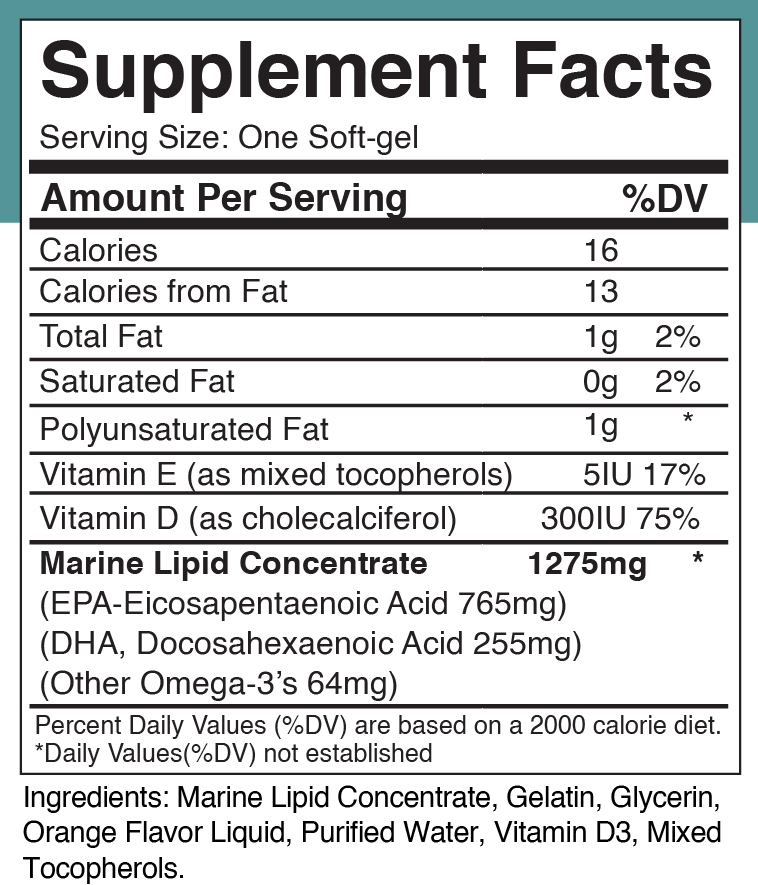
EPA and DHA, 1,020 mg in a single softgel. These are the two long-chain omega-3s the clinical research is built on, and they are studied at gram-level daily doses, which is exactly why concentration matters. Each softgel delivers 765 mg of EPA and 255 mg of DHA, so about 80% of the oil is EPA and DHA (85% counting all omega-3s), which is why you reach a real, research-level dose in a few softgels instead of a fistful. Think of EPA as the cell’s peacekeeper, the omega-3 most studied for supporting a healthy inflammatory response throughout the body. In plain terms, fewer pills, more of what you actually came for.
The re-esterified triglyceride (rTG) form. This is the step most brands skip because it costs more. After the oil is concentrated as an ethyl ester, we take it one expensive step further and re-esterify it back into the triglyceride form, the same form omega-3s take in real fish, the form studied for more efficient absorption than the ethyl ester. Think of DHA as a structural beam, a major building block of the brain and of the cell membranes throughout your body, which is the second reason the form you absorb matters so much. You get pharmaceutical potency without trading away absorption, so the dose on the label is closer to the dose your body keeps, which is the entire point of the word “ultra.”
Molecular distillation. This is how the heavy metals, PCBs, and dioxins come out. The oil is distilled until those toxins fall below the level standard testing equipment can even detect, which is why they show up on the lab report with a “less than” sign instead of a number. You are not asked to take purity on faith here. It is measured, and it is shown. What that means for you is simple, you are adding clean oil to your body and nothing you were trying to keep out.
Freshness, proven by a low TOTOX score. TOTOX is the total-oxidation score, the honest measure of whether an oil is fresh or quietly turning. The industry ceiling is a TOTOX of 26. Ours runs several times under that ceiling, which is what gives it an 18 to 24 month shelf life and, more importantly, means the oil going into you is clean and stable rather than a source of the free radicals you were trying to fight. Fresh oil is the difference between fish oil that helps and fish oil that works against you.
Per-ingredient detail is in the Ingredients section below.
What to look for in any fish oil, and how we measure up
If you only learn five things about how to judge a fish oil, learn these. They are the only specs that separate a serious oil from a poor one, and most labels go quiet on every one of them.
First, concentration: how much of the oil is actually EPA and DHA. A typical drugstore oil is around 30%. Ours is about 80% EPA and DHA (85% counting all omega-3s), which is 1,020 mg of EPA and DHA in a single softgel. Second, the form: triglyceride versus ethyl ester. Most concentrated oils stop at the cheaper ethyl ester. Ours is re-esterified back to the triglyceride form your body is built to absorb. Third, purity: whether heavy metals, PCBs, and dioxins are molecularly distilled out, and whether anyone shows you the result. Ours are distilled below detection and printed on the lab report. Fourth, freshness: whether the oil’s oxidation, its TOTOX score, is published at all. Most never print it. Ours runs well under the industry ceiling of 26. Fifth, third-party testing: whether an outside lab verified all of the above. Ours did, and the certificate is one click away.
Take those five questions to any fish oil on any shelf. The honest ones will be able to answer them. Most cannot.
Who this is for
This is for the person who already runs the body as a system and takes the inputs seriously. You read labels. You have taken fish oil for years, and somewhere along the way you admitted to yourself that you have no idea whether the one in your cabinet is any good. You want the cleanest, most potent version that exists, and you want to see the proof instead of the marketing. You would rather have the real, measured number than the big number on the front of the bottle.
It is also for the 55 or 65 year old who can feel the small things adding up. The joints that take longer to loosen in the morning. The afternoon focus that is not quite what it was. The eyes and skin that feel drier than they used to. None of that is a disease. It is the slow drift that omega-3s, at a real dose held steady over time, are one of the most studied tools for pushing back against. The win you are after is mundane and enormous at the same time, mornings that start easier and afternoons you are still present for.
And it is the right starting point for anyone building a longevity routine. Omega-3s calm the systemic inflammation that wears on every other system, which is exactly why this is the first thing I ever built and the thing everything else I make is designed to sit on top of. Get this right first. Then build.
What you won’t find on the label
No 30% oil hiding behind a big milligram number. No ethyl ester sold as if it were the finished product. No detectable heavy metals, PCBs, or dioxins, because they are distilled out and the lab report proves it. No rancid, oxidized oil, because we measure freshness when most brands will not. No fillers, and no reformulation tricks to cover for an oil that has already turned.
I take this every day, with my biggest meal, the way I tell my patients to. I have taken it every day for the better part of twenty years. I am always my own first test subject, and this is the one product I have never once stopped using since the day I made it.
Get the foundation right, and everything you build on top of it works better. That is not a slogan. That is the order your body works in.
— Dr. Dave